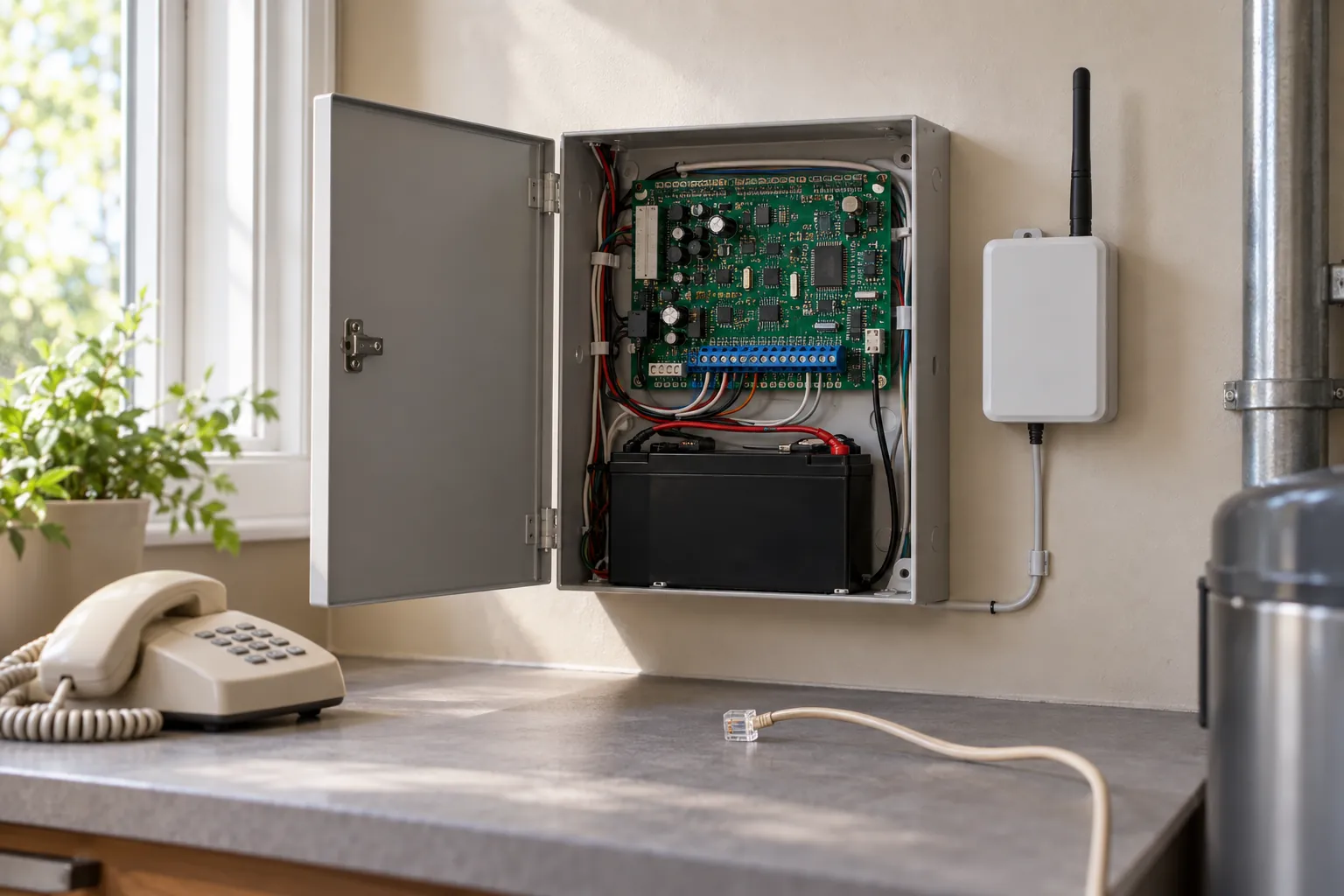
Home alarm control panel with backup battery and a cellular communicator beside a disconnected landline telephone cable

Verizon Is Retiring Copper Landlines in NY & CT: Will Your Home Alarm Still Work?

Julio CabreraFounder & Lead Low-Voltage Technician9 min read

Last updated:

What's Changing: Verizon's Copper Landline Shutdown in NY & CT

Most home alarm systems will keep working after Verizon retires copper landlines, but only if someone checks them first. On September 9, 2026, Verizon and its Frontier companies asked the FCC to end copper phone (POTS) service at about 750,000 homes and businesses in parts of New York, Connecticut, seven other states and Washington, D.C., on or after November 30, 2026. Alarms that still dial the monitoring center over that line are the devices most likely to fail without warning.

If a letter from Verizon about your home phone arrived in September, this is why. The application covers residential and business copper voice service in parts of California, Connecticut, Illinois, Maryland, Massachusetts, Michigan, New York, Pennsylvania, West Virginia and D.C. That is roughly 2.7% of the locations Verizon serves, so not every address is included. Affected customers move to Fios Digital Voice (over fiber) or a wireless home phone that runs on Verizon's cellular network.

Connecticut readers: if your phone bill says Frontier, this applies to you too. Frontier, which bought AT&T's Connecticut landline business in 2014, has been part of Verizon since January 20, 2026.

Status as of October 6, 2026

  • September 2026: customer letters go out, and on September 9 Verizon files its Section 214 application for the group of states that includes New York and Connecticut.
  • Proposed date: on or after November 30, 2026, if the FCC approves.
  • September 25, 2026: the FCC pulled a different Verizon application (Arizona, Delaware, New Jersey, New Mexico, Ohio, Rhode Island, South Carolina, Utah and Virginia) out of automatic approval to give it more review. The FCC stressed that this is not a final decision, and the NY/CT application is a separate filing.
  • Verizon's position: "if a suitable replacement is not yet available, we will not discontinue a customer's copper voice service."

This article will be updated when the FCC acts on the New York and Connecticut application.
Why Your Alarm System Cares About the Phone Line

Many alarm panels report to the monitoring center the old-fashioned way. A built-in digital dialer picks up the phone line, calls the central station and sends a short burst of tones (usually in the Contact ID format) describing what happened. Three things change when copper goes away.

1. Copper carried its own power

A copper landline is powered from the phone company's central office, which is why the kitchen phone kept working through a blackout. Fiber and wireless home phones are powered by equipment inside your house. When that equipment's backup battery runs down, the line your alarm depends on goes dead.

2. Digital voice can garble alarm tones

Fios Digital Voice and wireless home phone turn your call into compressed data. Voices survive that easily; the precise tone sequences an alarm dialer sends don't always. Verizon says "most alarm systems and other home systems that communicate via phone line are compatible" with both replacements. The risk is the panel that works most of the time and drops the occasional signal, because nobody notices until the night it matters.

3. The alarm's line connection gets lost in the swap

Professionally installed panels are usually wired ahead of every phone in the house through a dedicated jack (an RJ31X), so the alarm can take over the line even if someone is on a call. When the service is converted and the new equipment is plugged into the nearest phone jack, that alarm wiring can easily be bypassed. The panel then has nothing to dial out on, and unless its phone-line monitoring feature is turned on, nothing warns you until it tries to report an alarm.

How to Tell If Your Alarm Uses the Landline (5-Minute Check)

  1. Call your monitoring company and ask two questions: "What is my system's primary communication path?" and "Is there a cellular or internet backup?" They can see both on your account in seconds.
  2. Look at the control panel, not the keypad. The panel is usually a metal cabinet in a closet, basement or garage. If a phone cable runs into it, it uses the landline. A cellular communicator is typically a separate module or a plug-in board labeled LTE.
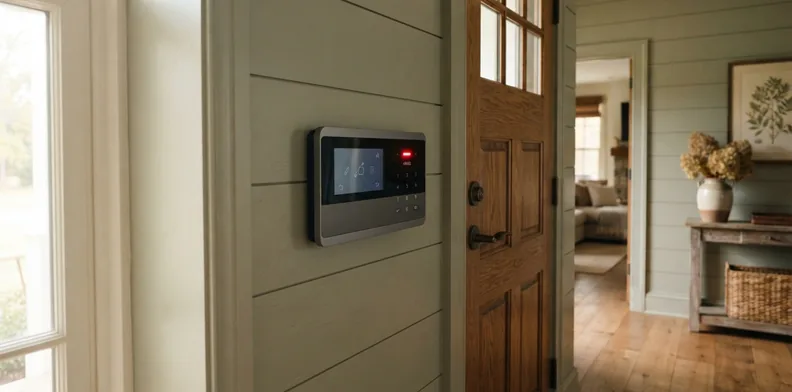
  3. Check the keypad for trouble messages such as "TLM," "Comm Fail" or "Failure to Communicate." Any of these means the system is already struggling to reach the monitoring center.
  4. Think back to 2022. When the national carriers shut down their 3G networks that year, alarm companies had to replace 3G radios across the country. If your system was upgraded then, you probably already report over LTE cellular, and the copper change matters much less.
  5. Read your Verizon letter. It tells you whether your address is in the affected area and which replacement service you'll get.
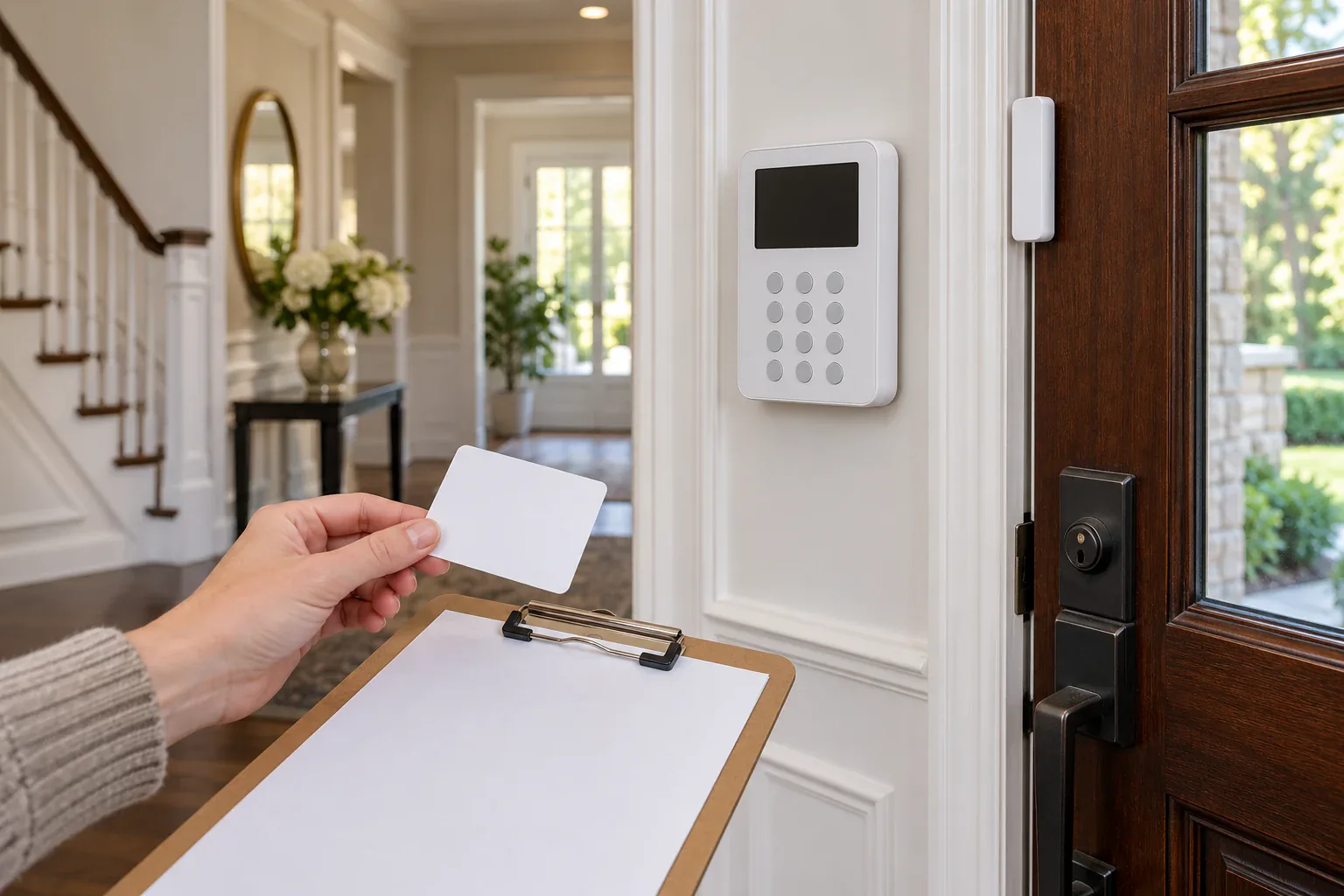
Home alarm keypad mounted beside the front door — the keypad shows trouble messages, while the dialer lives in the control panel

How to Test Your Alarm After the Switch

Don't assume; test. It takes about ten minutes, and it is the only way to know your signals actually arrive.

  1. Call the monitoring center and ask them to put your account on test for 30 minutes, so nobody is dispatched.
  2. Arm the system and trip a burglary zone, for example by opening a protected door.
  3. Ask the operator to confirm they received the signal and which zone it named. A dial tone on your phone isn't proof; a received signal is.
  4. Take the account off test when you're done.
  5. Repeat after any change to your phone, internet or power equipment, and at least once a year anyway.

If the test fails, the fix is usually a communicator upgrade, covered next.

Alarm monitoring center operator with a headset — a signal received on their screen, not a dial tone, proves the alarm works

Your Upgrade Options: Cellular, Dual-Path or Internet

Moving the alarm off the phone line entirely is the durable fix. Most professional panels from the major manufacturers accept an add-on communicator, and many newer panels have one built in.

PathIf the internet is downIf the power is outBest for
Landline dialer on digital voiceDepends on the phone serviceWorks only while the phone equipment's battery lastsA temporary bridge, not a plan
Internet (IP) communicatorFailsWorks only if the router and fiber terminal are on battery backupA secondary path
Cellular (LTE) communicatorKeeps workingKeeps working on the panel's batteryMost homes: the standard upgrade
Dual-path (cellular + internet)Keeps workingKeeps working on cellularEstates, second homes, monitored fire

Questions to ask before you sign

  • Is the radio LTE or newer? Avoid anything older. The 3G shutdown already stranded one generation of alarm radios.
  • How often is the communicator supervised? A supervised path checks in on a schedule, so the monitoring center learns when it goes silent. Ask what interval yours uses.
  • Does my monitoring plan change? Cellular reporting is sometimes billed differently. Get the new monthly figure in writing.
  • Is my town alarm registration still accurate? If the upgrade changes your monitoring company, update your permit. Greenwich homeowners can follow our Greenwich alarm permit guide.

A cellular communicator is also harder to defeat than a phone line, which can be cut where it enters the house. If tamper resistance matters to you, our guide to how burglars try to disable security systems covers jammers, cut lines and dual-path supervision.

Will Your Alarm Work When the Power Goes Out?

Your alarm panel's battery is only half the answer. The other half is whatever carries its signal out of the house.

Lower Westchester and Fairfield County know outages well. Storms in early July 2026 cut power to about 173,700 Con Edison customers, and in Westchester, Yonkers, Mount Vernon, Rye and New Rochelle saw the most outages. Here is how each link in the chain behaves when the lights go out:

  • The alarm panel runs on a sealed backup battery. UL-listed household burglar alarm panels are designed for at least 4 hours of standby power, and household fire alarm systems for 24 hours. Batteries weaken with age; most installers replace them every three to five years.
  • Fios Digital Voice or wireless home phone needs power at your house. Under FCC rules, providers of these services must offer to sell you a backup power option that lasts at least 8 hours, plus a 24-hour option. Verizon says both replacements come with battery backup; ask what yours includes and how to check it.
  • Your router and fiber terminal (ONT) go dark without power unless they're on a UPS. That takes down any internet-only alarm path, and every Wi-Fi camera with it.
  • A cellular communicator runs off the panel's battery and doesn't care whether your house has power or internet, as long as the cell network is up.

For long outages, the multi-day kind that follow nor'easters and ice storms, a whole-house generator or a properly sized UPS in your network closet keeps the alarm, cameras and Wi-Fi running. To keep camera recordings going through an outage, see NVR vs. cloud storage.

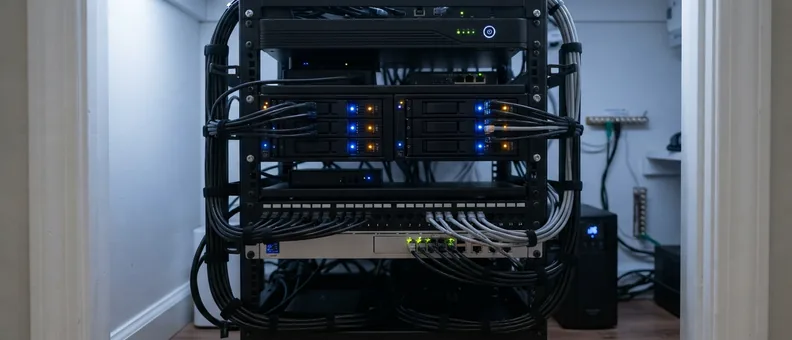
Home network rack with a battery backup unit beside it — the equipment that now carries phone, internet and alarm signals

Other Devices That Still Depend on Your Landline

The alarm is the big one, but walk the house for anything else plugged into a phone jack:

  • Gate and driveway call boxes. Many telephone-entry systems on estate gates dial the house over a phone line. Test the call box and its remote gate release after the switch.
  • Medical alert pendants that use a landline base station. Ask the provider about a cellular model.
  • Home elevator emergency phones, if your elevator has one.
  • Monitored fire alarm panels in businesses. These follow fire code (NFPA 72), and changes must be coordinated with your local fire marshal. See our fire alarm requirements guide for CT & NY.
  • Fax machines and older card terminals in home offices and shops.

Some of these are easy to forget because they only matter in an emergency. Make the list before your service changes, not after. Second-home owners should do it on their next visit; our vacation home monitoring guide covers what else to check while you're there.

Your Pre–November 30 Checklist

  1. Find your Verizon letter and confirm whether your address is affected.
  2. Call your monitoring company to confirm your communication path and whether a cellular backup exists.
  3. If the alarm reports over the landline only, schedule a cellular or dual-path communicator upgrade.
  4. Replace a panel battery that is more than three to five years old.
  5. Put your router, fiber terminal and any camera recorder on battery backup.
  6. List every other phone-line device: gate call box, medical alert, elevator phone, fax.
  7. After any change, run a monitored test and get the operator's confirmation that the signal arrived.

Want a second set of eyes? We check alarm systems across Westchester and Fairfield County (communicator, battery, phone wiring and monitoring path) and tell you honestly whether anything needs to change. Book a free consultation or call (914) 247-9506.

Sources

Need expert advice? Get a free consultation.

Licensed installers in CT & NY — no obligation.

Frequently Asked Questions

Is Verizon shutting off copper landlines in New York and Connecticut?

Verizon has asked to. On September 9, 2026, Verizon and its Frontier companies applied to the FCC to discontinue copper phone service at about 750,000 locations in parts of New York, Connecticut, seven other states and D.C., on or after November 30, 2026. The request is pending, and Verizon says it won't end service where no suitable replacement is available.

Will my alarm system work with Fios Digital Voice?

Usually. Verizon says most alarm systems are compatible with Fios Digital Voice and its wireless home phone. But older dialers can drop signals over digital voice, and the alarm's phone wiring is sometimes disconnected during the conversion. The only proof is a monitored test in which the central station confirms it received your signal.

Do I need a cellular communicator for my alarm?

If your alarm reports only over the landline, a cellular (LTE) communicator is the most reliable upgrade. It sends signals over a cellular network that is independent of your phone service, internet and house power, and it keeps working on the panel's backup battery during an outage.

Does my alarm work during a power outage without a copper landline?

The panel runs on its backup battery: UL-listed household burglar panels are designed for at least 4 hours of standby and household fire systems for 24 hours. But a Fios or wireless home phone line only works while its own battery lasts. A cellular communicator removes that dependency.

How do I know if my alarm still uses a landline?

Ask your monitoring company for your system's primary communication path, or look for a phone cable running into the alarm control panel. Trouble messages such as 'TLM' or 'Comm Fail' on the keypad mean the system is already having trouble reaching the monitoring center.

About the author

Julio Cabrera

Julio Cabrera

Founder & Lead Low-Voltage Technician

Julio founded Rolo Electronics in 2014 after a decade installing commercial CCTV and structured cabling across Westchester and Fairfield counties. He personally oversees every residential design at Rolo, focusing on hidden cabling, local NVR storage, and contract-free systems for Greenwich, Stamford, and Rye estates.

LinkedIn

Related Articles

Back to all articles