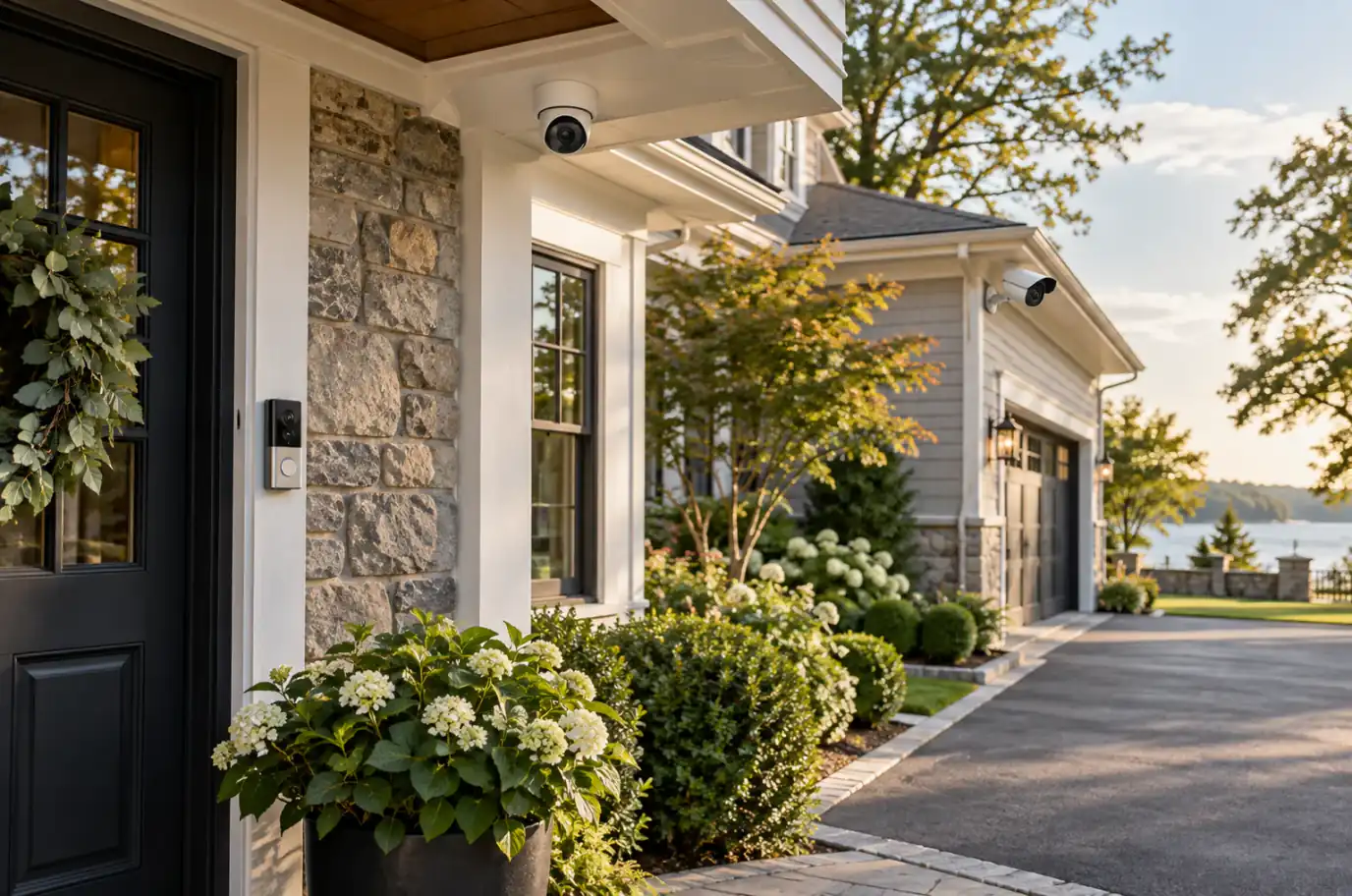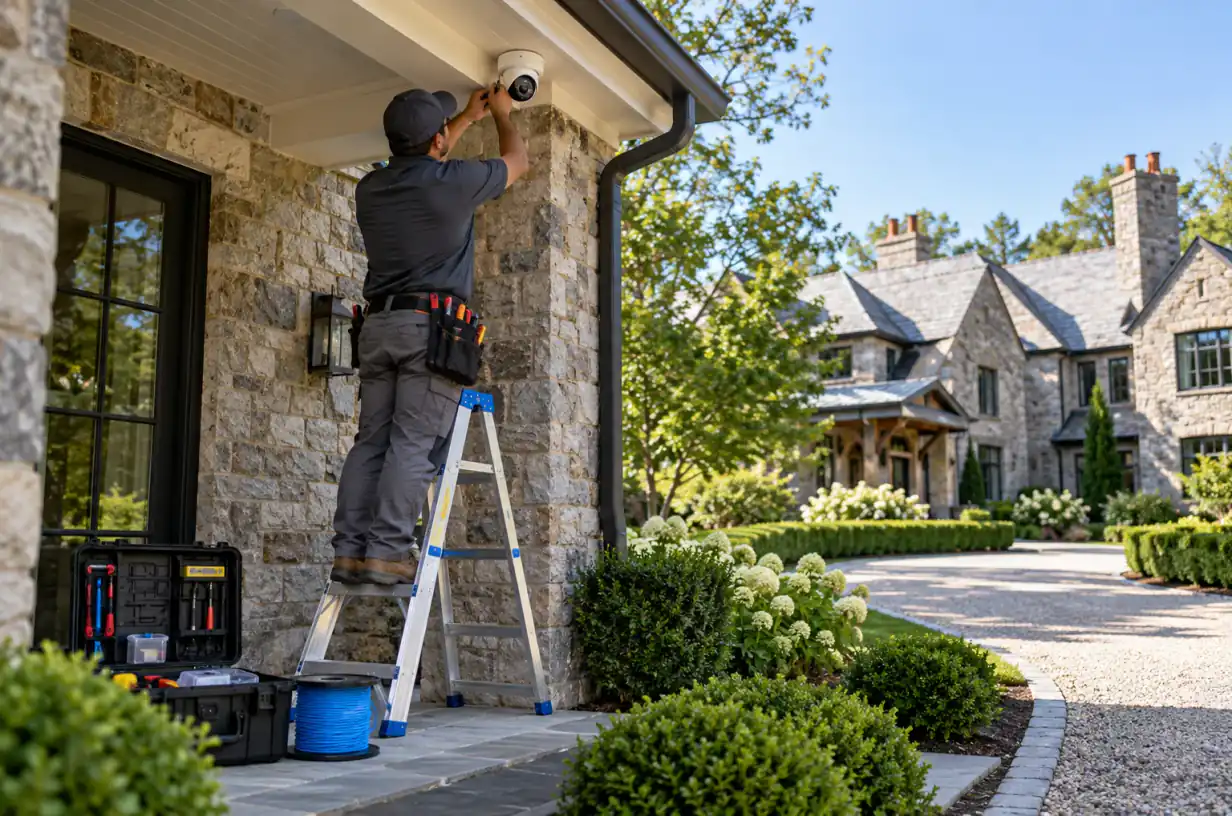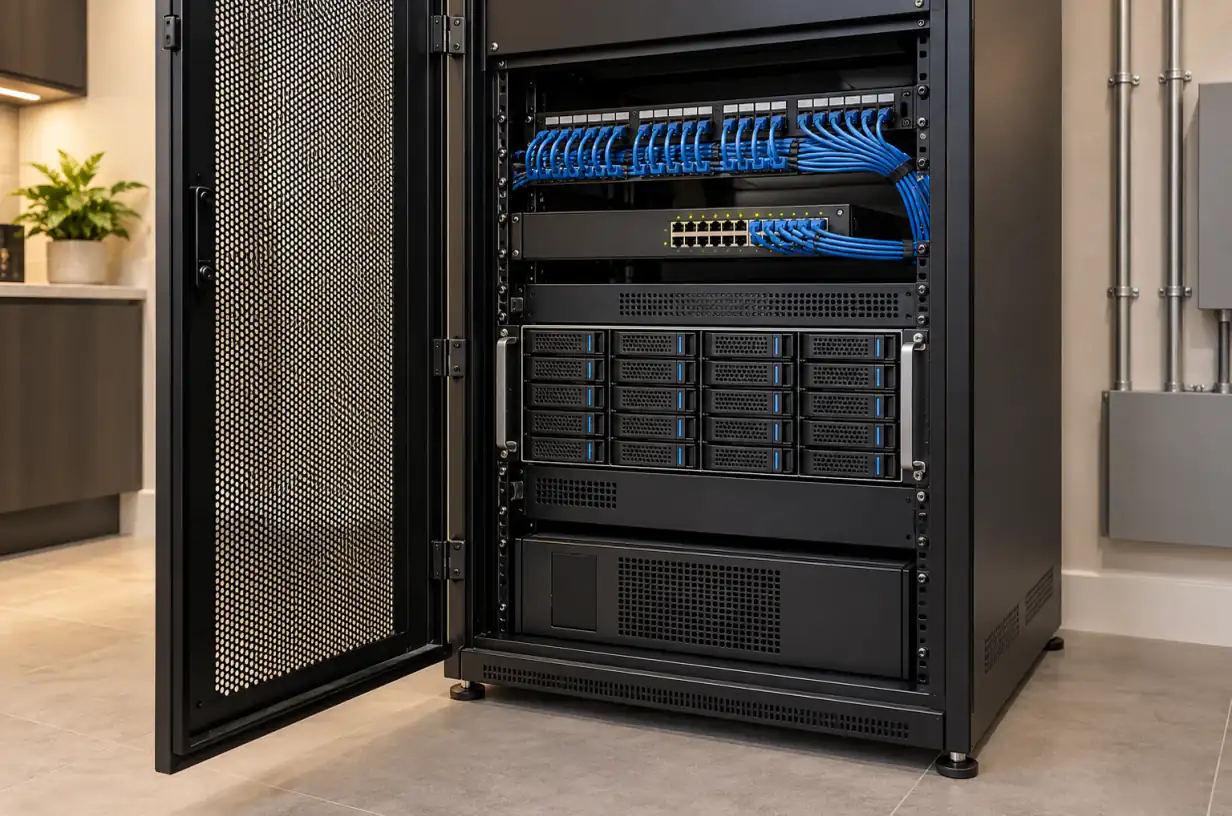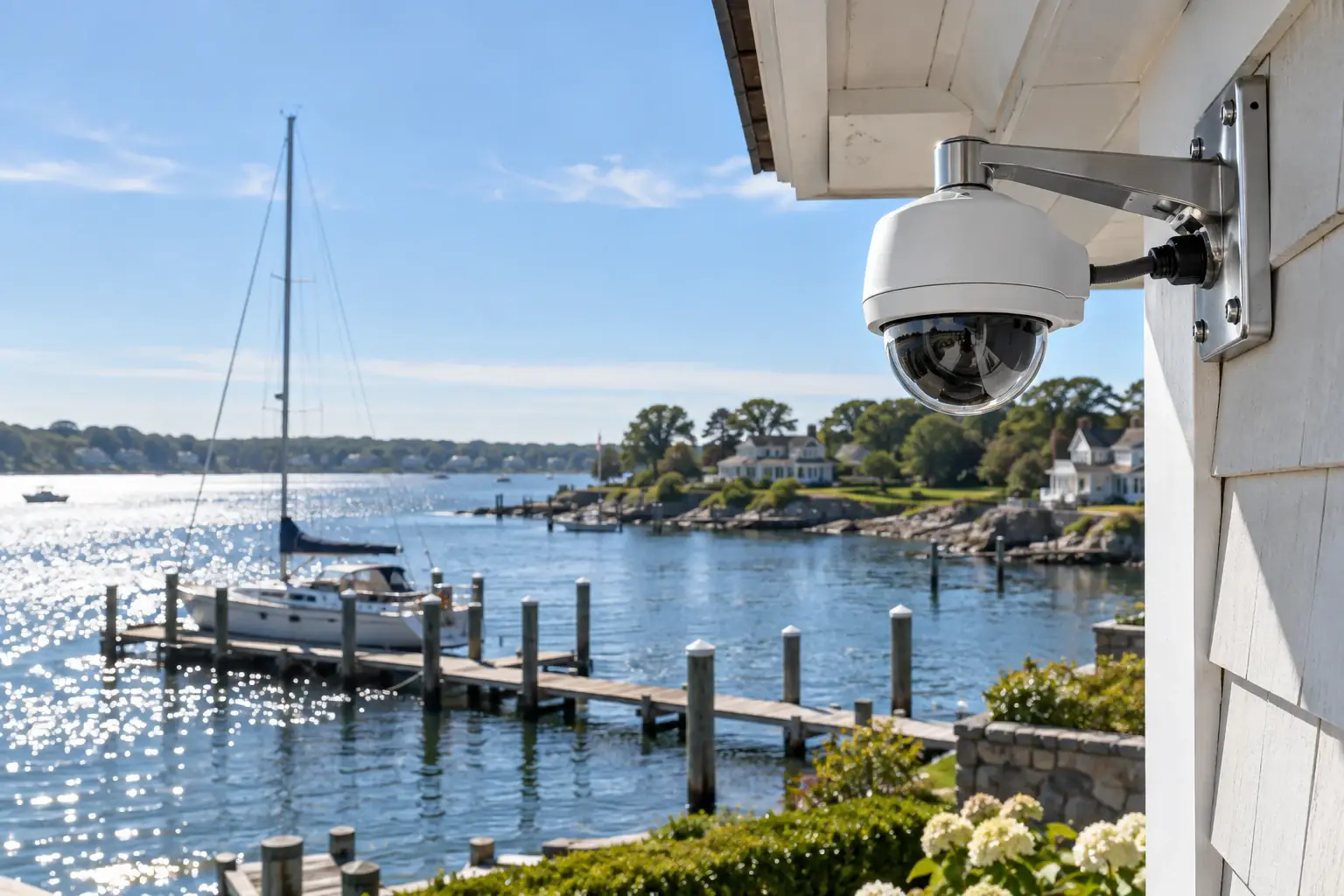
Greenwich CT waterfront estate in Belle Haven with private dock and security cameras

Waterfront Security Cameras in Greenwich: Salt-Rated Systems for Belle Haven & Riverside

Rolo Electronics Team10 min read

Last updated:

Quick Answer — Waterfront Camera Essentials

Greenwich waterfront homes in Belle Haven, Riverside, Old Greenwich and Mead Point need cameras rated IP67 or higher, housed in marine-grade stainless or polymer enclosures, mounted with 316-grade stainless hardware, and connected via shielded outdoor-rated Cat6 with surge protection. Standard “outdoor” cameras marketed for suburban homes fail within 12–24 months in direct salt-air exposure.

The three failure modes we see most often on waterfront replacements: corroded mounting brackets that drop the camera in the first nor’easter, gasket failure on IP66-rated housings after 2 hurricane seasons, and PoE port oxidation where the RJ45 connector meets the camera body.


Greenwich CT waterfront property with sandy coastal edge and private pier

What Makes Waterfront Camera Installs Different

A camera on a Back Country colonial never sees what a Belle Haven camera sees in one winter. Four environmental factors change the entire spec:

  • Salt aerosol — coastal wind deposits microscopic salt particles on every surface within 200 feet of open water. Salt is hygroscopic (it pulls moisture from the air), which means camera housings, mounts, and connectors stay wet even on dry days.
  • Wind loading — exposed waterfront mounts see 40+ mph gusts regularly, 70+ mph during nor’easters and hurricanes. Standard mounting brackets aren’t engineered for this.
  • UV exposure — reflective water intensifies UV. Camera housings that last 8 years inland fade, crack, and lose seal integrity in 3–4 years waterfront.
  • Storm surge and ice — the waterline changes. Cameras mounted too low see salt-water immersion during spring tides and ice buildup in winter.

Plan the install for the worst day of the year, not the calmest.

IP66 / IP67 / IK10 Ratings Explained

Camera marketing throws around IP ratings without explanation. Here’s what actually matters for Greenwich waterfront:

RatingWhat It MeansWaterfront Use?
IP65Dust-tight, low-pressure water jetsNo — insufficient for coastal spray
IP66Dust-tight, powerful water jetsMinimum acceptable, 3–4 yr life
IP67Dust-tight, temporary immersion to 1mRecommended standard
IP68Continuous submersionIdeal for dock-edge mounts
IK1020J impact resistanceAdd for storm-exposed positions

For Belle Haven and Riverside, we spec IP67 + IK10 as the minimum. For Mead Point peninsulas and direct harbor exposure (Greenwich Harbor, Cos Cob Harbor, Smith Cove), we step up to IP68 housings with additional marine gaskets.

Salt Air Corrosion — The Silent Killer

Most camera warranties exclude "coastal environments" or "marine applications." The manufacturer knows standard construction doesn’t last in salt air. Our mitigation playbook:

  • 316-grade stainless steel hardware — not 304. The additional molybdenum in 316 resists pitting from chloride exposure. Every screw, washer, bracket, and mount must be 316. One galvanized fastener accelerates corrosion on everything it touches.
  • Marine-grade polymer or powder-coated housings — avoid bare aluminum. Anodized aluminum is acceptable; raw aluminum develops white oxide within months.
  • Dielectric grease on all connectors — a thin layer on RJ45 pins, power connectors, and threaded entries prevents the galvanic corrosion that kills most waterfront cameras.
  • Shielded outdoor Cat6 (FTP or STP) — unshielded cable lets salt moisture migrate through the jacket and corrode conductors from the inside.
  • Annual rinse maintenance — once a year, we rinse every camera with fresh water (not pressure-washed) to remove accumulated salt. This alone extends waterfront camera life by 3–5 years.

Best Cameras for Belle Haven Coastal Properties

Our top three camera models for Greenwich waterfront installs in 2026:

  1. Axis Q1798-LE — Axis’s marine-reputation line. IP67, IK10+, salt-spray tested per IEC 60068-2-52 (168 hours of direct salt spray exposure). Around $3,800–$4,500 retail per camera, the premium tier for properties where reliability trumps budget.
  2. Hikvision DS-2CD2T87G2H-LI with stainless housing — an IP67 4K bullet camera fitted into an aftermarket 316-stainless enclosure. Our mid-range choice at $800–$1,200 installed per camera.
  3. Dahua IPC-HFW5849T1-ASE-LED with marine mount — similar tier to the Hikvision, strong color night vision, excellent for dock and pier coverage. $700–$1,000 installed per camera.

Avoid wireless/battery cameras for waterfront. The salt destroys battery contacts within 2 seasons, and wireless reliability collapses near water due to RF reflections.

Professional weatherproof security camera mounted on a coastal property soffit

Mounting Hardware — Why Stainless Matters

A $1,200 waterfront camera on a $12 galvanized bracket fails at the bracket, not the camera. We see this every spring, replacing cameras that fell 15 feet off cedar-shake siding because the mounting hardware corroded through.

  • 316 stainless brackets and bases — $45–$120 each depending on size. Non-negotiable.
  • 316 stainless or silicon-bronze fasteners into cedar, teak, or mahogany trim. Never steel into cedar — the tannins in the wood accelerate steel corrosion dramatically.
  • Neoprene or EPDM gaskets behind the bracket base to prevent water intrusion into the mounting substrate. Cheap foam gaskets disintegrate in 2 years.
  • Drip loops in the cable entry so water runs off rather than pooling at the gland
  • Back-caulked penetrations with marine-grade sealant (3M 5200 or Sikaflex 291) rather than standard silicone

Dock and Boat Slip Monitoring

For homes with private docks on Long Island Sound, a dedicated camera covering the slip and dock approach is essential. Common setups:

  • PTZ camera with 30x zoom mounted at the house (100–300 ft from dock) to monitor vessels and approaches without requiring power at the dock itself
  • Fixed IP67 bullet cameras on the dock with local power via trenched conduit to the house — PoE with surge protection
  • Long-range wireless bridge (Ubiquiti airFiber or NanoStation) for docks beyond 300 ft from the house network
  • Thermal overlay cameras (FLIR, Hikvision thermal) for nighttime approach detection in fog — the Greenwich Harbor area gets marine fog 20+ nights per year

Local harbor masters for Greenwich Harbor and Cos Cob Harbor appreciate footage for incident documentation — several of our clients have recovered property by sharing camera footage during marine investigations.

Private Beach & Shoreline Coverage

Belle Haven Land Company properties and Old Greenwich beach club homes often include private shoreline. Coverage priorities:

  • Wide-angle (120°+) cameras to cover beach approaches without requiring PTZ follow
  • Elevated mounting (second-story soffit or pole mount) to clear wind-blown sand and surf spray
  • Tide-aware mounting heights — plan for spring tides 3–4 feet above mean high tide
  • Dune-vegetation planning — beach grass and Rosa rugosa can block line-of-sight within 1–2 growing seasons. Cameras positioned above predictable growth height save future relocation labor.

Be aware of Greenwich’s coastal setback regulations and any restrictions from the Greenwich Conservation Commission or the CT Department of Energy & Environmental Protection — some coastal positions require permits for pole mounting.

Storm Preparedness for Waterfront Systems

Coastal Greenwich lost power multiple times in the 2025 winter storm season. A resilient waterfront camera system handles this through:

  • UPS battery backup on the NVR and network switch (minimum 2-hour runtime)
  • Whole-house generator integration — NVR on the essential circuits panel so it rides through extended outages automatically
  • Cellular backup communication — if cable internet goes down during a storm, the NVR should fail over to cellular (4G/5G modem with VPN to cloud storage for critical footage)
  • Lightning surge protection — PoE surge protectors on every outdoor run ($35–$60 each). Coastal lightning exposure is 2–3x higher than inland Greenwich.
  • Pre-storm “lock down” protocol — confirm NVR is recording, generator fuel is full, and windborne-debris vulnerable cameras are temporarily pulled or protected

Get a Waterfront Property Assessment

Every waterfront property in Greenwich has different wind exposure, salt load, and architectural constraints. A 30-minute site walk identifies issues that cost thousands to fix after install.

Book a free private consultation:

We serve Belle Haven, Riverside, Old Greenwich, Mead Point, Cos Cob Harbor, Greenwich Harbor, Stanwich, and adjacent coastal Fairfield County communities.

Sources

Need expert advice? Get a free consultation.

Licensed installers in CT & NY — no obligation.

Related Articles

Back to all articles
Need help? Text us!